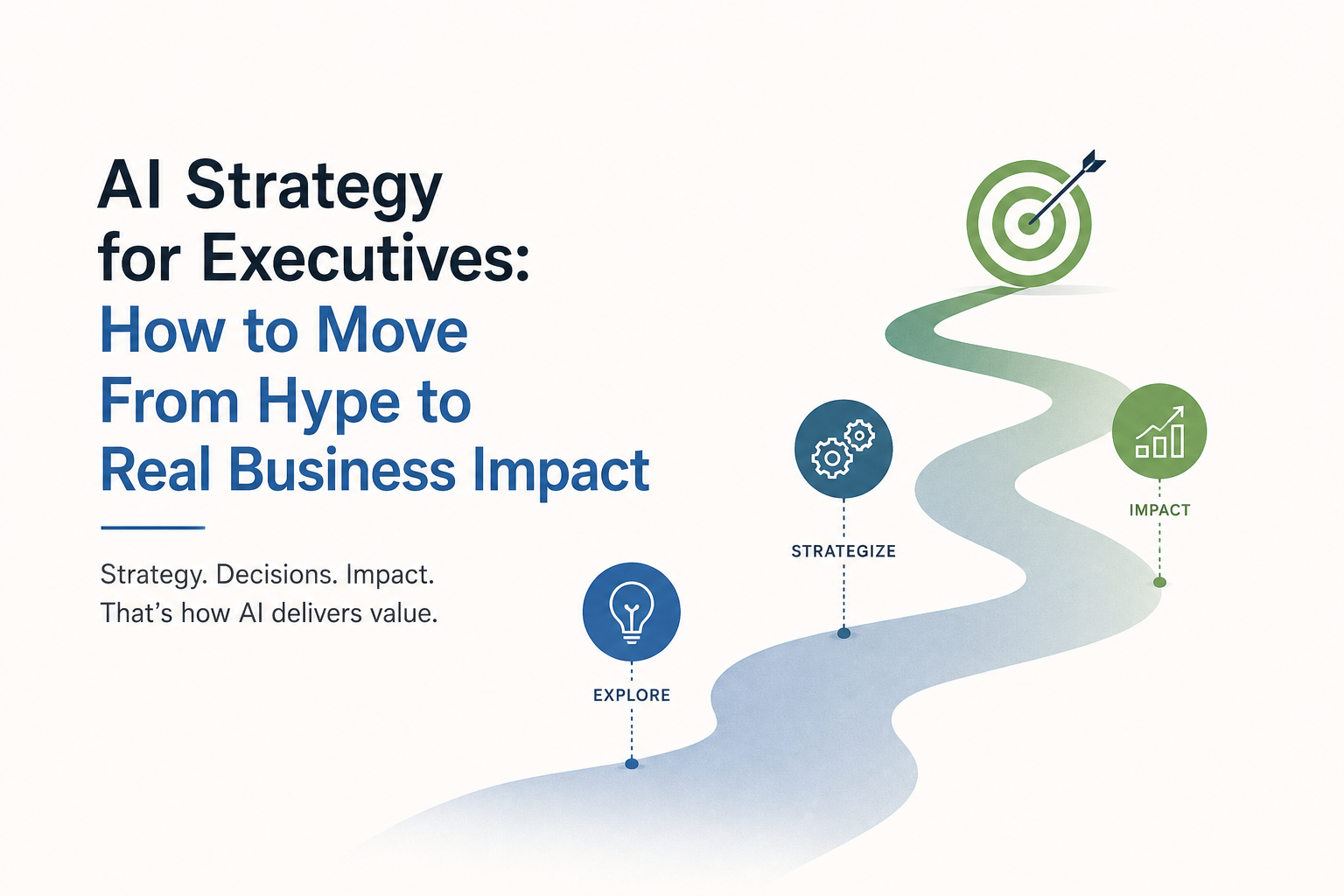
Let’s be honest about where most companies actually are with AI right now.
You’ve approved a few pilots. Your teams are using ChatGPT, Copilot, or something similar. There’s probably a slide in your last board deck with “AI strategy” somewhere in the title. And yet, when someone asks what AI is actually doing for the business — the concrete, measurable kind of doing — the answer gets fuzzy fast.
You’re not alone. Most organizations are stuck in what I call the adoption gap: AI is present, but it isn’t yet strategic. The gap between deploying AI tools and extracting real business value from them is where most executive energy should be focused right now. And it’s not a technology problem — it’s a leadership one.
The Pilot Trap
Here’s a pattern that plays out constantly: a team runs an AI pilot, it works reasonably well, leadership celebrates the win, and then… nothing scales. Six months later, the same organization is running three more pilots in different departments, none of which are connected, and still can’t point to a meaningful line on a P&L.
The pilot trap happens when AI adoption is driven by curiosity rather than strategy. Pilots are valuable — they test assumptions, build internal capability, and create proof points. But a portfolio of pilots is not a strategy. At some point, leadership has to make the call: which of these bets do we scale, which do we kill, and what does AI actually mean for how we compete?
That call is a business decision, not a technology decision. Which is exactly why it belongs in the room you’re sitting in.
What “AI Strategy” Actually Means
There’s a lot of noise around this phrase, so let’s simplify it.
An AI strategy answers three questions:
Where does AI create disproportionate value for our specific business? Not AI in general — AI in your context, with your data, in your competitive landscape. A logistics company and a professional services firm have very different answers here.
What do we need to build, buy, or change to capture that value? This is the operational side: data infrastructure, talent, vendor relationships, process redesign. Most organizations underestimate how much non-AI work is required to make AI work well.
How will we know if it’s working? AI investments need success metrics tied to business outcomes, not technology outputs. “We deployed a model” is not a metric. “We reduced customer churn by 8% in the segments where the model runs” is.
If your organization can answer all three questions clearly, you have a strategy. If the answers are vague or vary depending on who you ask, you have a direction, which is a start — but it needs to become something more concrete.
The Decisions Only You Can Make
One of the most common mistakes I see is executives treating AI adoption as something to delegate entirely. Hand it to IT, hire a Chief AI Officer, let the innovation team figure it out. The thinking goes: this is technical, so technical people should own it.
The problem is that the highest-stakes AI decisions aren’t technical at all. They’re about risk tolerance, competitive positioning, and values. Consider:
- Which decisions are you willing to let AI make autonomously, and which ones require a human in the loop?
- If your AI system produces a result that turns out to be wrong, who is accountable — and what’s the remediation path?
- Are there customer-facing use cases where using AI might be effective but would feel wrong to your customers if they knew about it?
These questions don’t have technical answers. They require judgment about what kind of company you want to be, what your customers expect, and how much risk is appropriate given the upside. That’s leadership work, and it can’t be delegated.
Three Practical Things to Do in the Next 90 Days
If you’re a C-suite leader who wants to move from good intentions to actual traction with AI, here’s a practical starting point.
1. Get a real inventory of what’s running. Before you build anything new, understand what you already have. How many AI tools are active across your organization? Which teams are using them? What data are they touching? You may be surprised — and in some cases, concerned — by the answer. This isn’t a witch hunt; it’s a baseline. You can’t govern or scale what you haven’t mapped.
2. Pick one high-value problem and go deep. Rather than spreading investment across five “exploration” efforts, identify one business problem where AI could create significant, measurable impact — and resource it properly. Give it dedicated ownership, clear success metrics, and a realistic timeline. Breadth feels innovative; depth actually delivers.
3. Have the accountability conversation. For every AI system your organization runs, there should be a named individual — not a team, not a committee — who is accountable for its outputs. If something goes wrong, who calls it and who fixes it? That clarity doesn’t slow you down. It’s what lets you move quickly without flying blind.
On the “We’ll Figure It Out Later” Approach
There’s a natural temptation to move fast and deal with governance, accountability, and strategy later — once you’ve proven the technology works. The logic seems reasonable: why slow down to build infrastructure for a bet that hasn’t paid off yet?
Here’s the practical problem: later is expensive. When you build accountability and oversight into AI systems after they’re running in production, you’re not adding structure to an empty foundation — you’re retrofitting it into decisions that have already been made, processes that have already changed, and outputs that have already influenced outcomes. That work costs significantly more in time and money than building it right the first time.
The organizations that are scaling AI most effectively right now aren’t moving recklessly fast. They’re moving with intention — deploying quickly into well-defined problem areas, with clear ownership, real metrics, and a short feedback loop. Speed and discipline aren’t opposites in AI adoption. They’re what each other requires.
The Competitive Reality
AI adoption is not going to be a differentiator forever. Right now, there’s still meaningful separation between organizations that are using AI strategically and those that are still in “exploratory mode.” That window is closing. Within two to three years, the baseline expectation in most industries will be that AI is embedded in core operations — customer service, forecasting, risk management, product development.
The question isn’t whether AI will be part of how your business runs. It’s whether you’ll have built the capability, the data infrastructure, and the organizational habits to use it well before your competitors do.
That’s not a technology question. That’s a strategy question. And it’s yours to answer.
The best place to start is a clear-eyed assessment of where you are today — not where your roadmap says you should be. What does AI actually do for your business right now, and what would it need to do differently to matter at the level you’re planning for?
Leave a Reply